


 30 / 84

28
Officelayout 167
ottobre-dicembre 2016
SMART OFFICE: destination or transition?
absolutely versatile products that can adapt,
evolving for different functional and
conceptual needs, addressing operative and
support spaces in the same way, with the
same language, the same architectural key,
though with completely different functions.
These same products can be grouped with
existing ones, forming systems that
contaminate each other in a scenario of
hybridization between finishes, feel,
materials, spaces, forms. All these factors
combined convey an image of the present
needs of the market: companies have
more success when they propose a vision
of freedom and a wide range of solutions,
not just products.”
The pursuit of a balance between the
needs of users and those of companies is
a constant in the design of furnishings at
Herman Miller, says Matteo Parma, sales
director for Italy: “Today the requests of
clients are multiple, but they mainly focus
on two themes: greater efficiency and
greater productivity. We are convinced
that this goal can be achieved by
designing spaces that respond to basic
human needs: our research identifies
these fundamental needs as a sense of
fulfillment, of purpose, a sense of security,
status, independence and belonging.
Therefore we pay close attention to
ergonomics, seen not only in physical
terms – though that is still very important,
because activities happen in many
different ways and contexts – but also and
above all in social terms, reflected in
relations, proxemics, privacy, territoriality.
The motivation also lies in the need to control
stress in the workplace, which in the long run
can cause physical discomfort and have a
negative impact on the way we think and do
our work. We believe ‘smart design’ should
carefully consider how to apply the principles
of design and new principles of organizational
behavior, to optimize the workspace in terms
of social ergonomics.”
New ways of using office space are taking
form, with greater integration of
technologies to monitor uses, interactions
and wellness in the workplace: an
increasingly wide range of settings will
support a variety of working activities in
the context of a “living office” with high
performance, offering a better experience
of work for people wile helping
organizations to achieve their strategic
objectives.
The future of the smart office
It is almost nonsensical to think about the
smart office as mere physical space,
precisely because its founding principles are
the exact opposite: to work in a smart way
you have to get away from the idea of a
physical space that exerts some form of
constraint. This is why, according to
Mantero, another trend is picking up steam:
“Today coworking appeals not only to
professionals who approach it to optimize
facility costs or to insert themselves in a
community of colleagues, but also the entire
world of startups, business incubators, as
well as companies that are increasingly
trying to get away from the constraints
involved in services, management costs,
organizational models. A coworking facility
can provide structures, suitable spaces,
centralized services to meet all
expectations. It is no longer just an
economic issue, because the point is to
provide quality with standards that a
company, with a single project, would be
hard pressed to obtain. Spaces have to be
designed, but the perspective in which the
architect continues to oversee a project for
a given company or a given building is one
thing, while reasoning about the fact that
the world of the office is moving towards a
much more capillary layout with respect to
the availability of traditional spaces is
another. Obviously in this sense mobility is
also very important, because everything
becomes systemic, especially for
companies that also pursue sustainability; it
becomes important to generate savings on
movements, while still having the possibility
of meeting with others in a physical
structure. To be able to have these spaces
with increasingly high quality, avoiding large
capital investments, represents a great
opportunity.”
But a provocative viewpoint emerges from a
conversation with the architect Marco
Predari, president of Assufficio of
FederlegnoArredo: “It is clear that the social
and functional mechanism that sustains the
themes of smart working has indubitable
force for application and governs many
choices of positioning and physical
transformation of the offices of companies.
But knowing about the large heritage of
office buildings found in all cities of a
certain size – and we are talking about
millions of square meters – a question
arises: are we certain that all these
buildings, 80% of which were built in a
traditional way, and their developers, are
capable of withstanding the high costs of
adaptation to the needs of smart working? I
believe we will soon be seeing a change of
trend, and in a perceptive article Carlo Ratti
himself has defended office work, because
it is in the office that ideas happen. In short,
my thinking about the future focuses on
offices that encourage cooperation amongst
individuals, with increasingly shared spaces,
but without the need to disrupt what already
exists, relying on furnishing systems and
technologies to act as elements of
integration between man, his needs, and
the physical container. Methods that can be
summed up as rapid intervention, increased
flexibility, easy personalization, which will
represent a great opportunity for
designers and manufacturers. An overview
on this theme will be presented at
Workplace3.0, during the upcoming
Salone Ufficio in April 2017: a moment in
which the conceptual contribution of four
authoritative designers will indicate the
coordinates of a multidisciplinary path in a
state of becoming.”
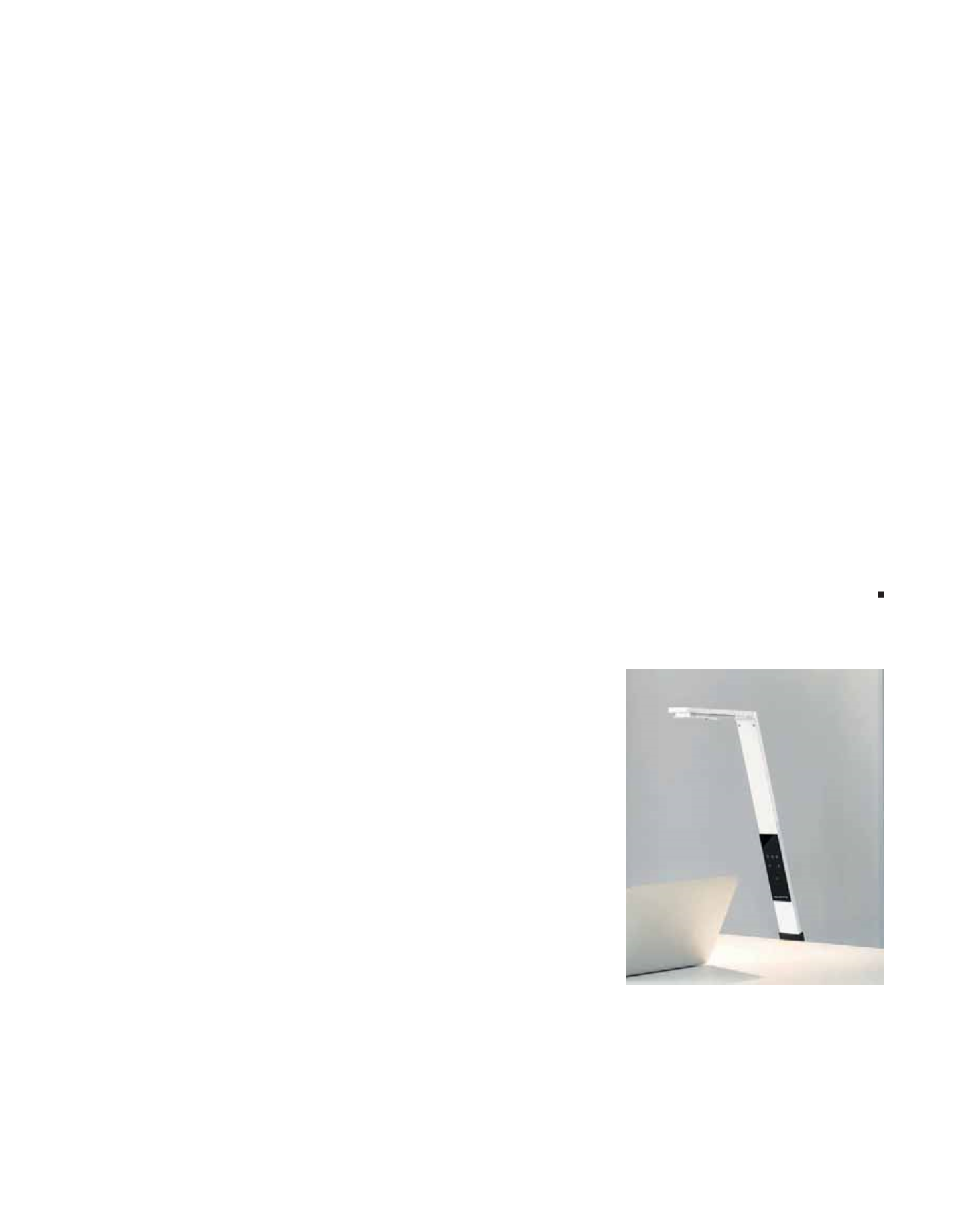
La crescente flessibilità, combinata con
l'aumento della mobilità dei lavoratori, comporta
postazioni di lavoro non definite e nuovi luoghi di
lavoro. Le lampade portatili
Flex di Luctra
consentono all'utente di portare la luce con sè,
grazie alla batteria incorporata che consente di
avere luce per quattro ore alla massima intensità
luminosa e per dieci ore con illuminamenti ridotti